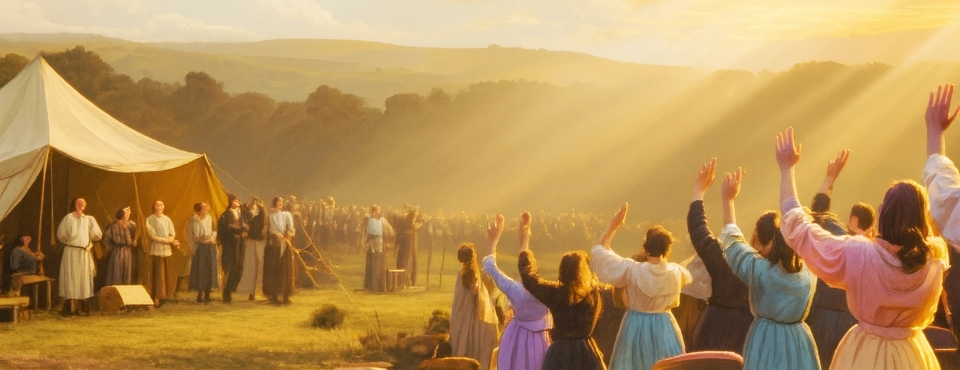

1801 Cane Ridge, KY
Present Day Revivals
Times of Refreshing Ministries
Gil & Loraine Howard-Browne

Listen to the Cane Ridge Revival audio.
Cane Ridge Revival of 1801
Today, we revisit the Cane Ridge Revival of 1801, a remarkable gathering in Kentucky
that not only shook the young American frontier but also revealed the deep divide
between living faith and institutional religion.
What began as a simple communion service organized by Barton W.
Stone, a Presbyterian minister, soon turned into a visitation of God that
would draw between twenty and thirty thousand people from across
the frontier. At a time when travel was slow and communities were
scattered, men and women walked, rode horseback, or traveled in
wagons just to be there , hungry, desperate, and expectant.
Denominations that once stood apart came together, laying aside
doctrinal differences to preach repentance, salvation, and the power of
the Gospel. For a brief moment, unity was visible, as believers declared
that heaven itself had touched earth.
The revival was marked by extraordinary manifestations of spiritual
power. Crowds wept, trembled, shouted, and fell to the ground,
overcome by a presence they could not explain. Some remained
prostrate for hours, gripped by conviction, until they cried out for mercy and found
salvation. Others were filled with joy and boldness, testifying to healing and
deliverance. There was no schedule, no campaign, no orchestrated plan , only the
unmistakable sense of divine visitation that would leave a lasting mark on the
spiritual landscape of a growing nation. From Cane Ridge, the tradition of camp
meetings and a renewed hunger for holiness spread across America, fueling what
would come to be known as the Second Great Awakening.
Yet alongside the outpouring came fierce opposition. Many leaders in the
established church condemned the revival as emotionalism, disorder, or worse ,
even the work of the devil. Instead of rejoicing over the lives changed and families
restored, they recoiled at the physical manifestations that offended their traditions.
Falling, trembling, and shouting did not fit within the neat confines of their
doctrines. Like the Pharisees in the time of Jesus, some dismissed what they could
not control, choosing skepticism over recognition of God’s hand.
This tension is one that has appeared throughout history. Every revival, it seems,
has faced resistance from the spirit of religion , the preference for order, structure,
and predictability over the unpredictable movement of God. At Cane Ridge, that
resistance only revealed the emptiness of a faith stripped of power. For those who
yielded, the revival was life-changing. For those who resisted, it became a moment
of debate rather than transformation.
In the end, Cane Ridge stands as both a testimony and a challenge , a reminder that
God often moves outside the boundaries of tradition, stirring the hearts of the hungry
and the broken. And it asks us a question still relevant today: when God moves in ways
we do not expect, will we embrace it, or will we resist?
This has been Perspectives – Past and Present. Join us next time as we continue to
uncover the moments where history and faith intersect, shaping the world we live in
today.
This is Perspectives - Past and Present,
The podcast where we explore the Revivals of the
past and present and how they shaped our world.
Copyright © 2020 - 2025 www.revivaltimes.online All rights Reserved
No portion of this site may be copied or transmitted without express
written permission from Times of Refreshing Ministries.




